Discover student orientation insights, tips, and strategies from experts
Guide to effective student orientations
Download the eBook





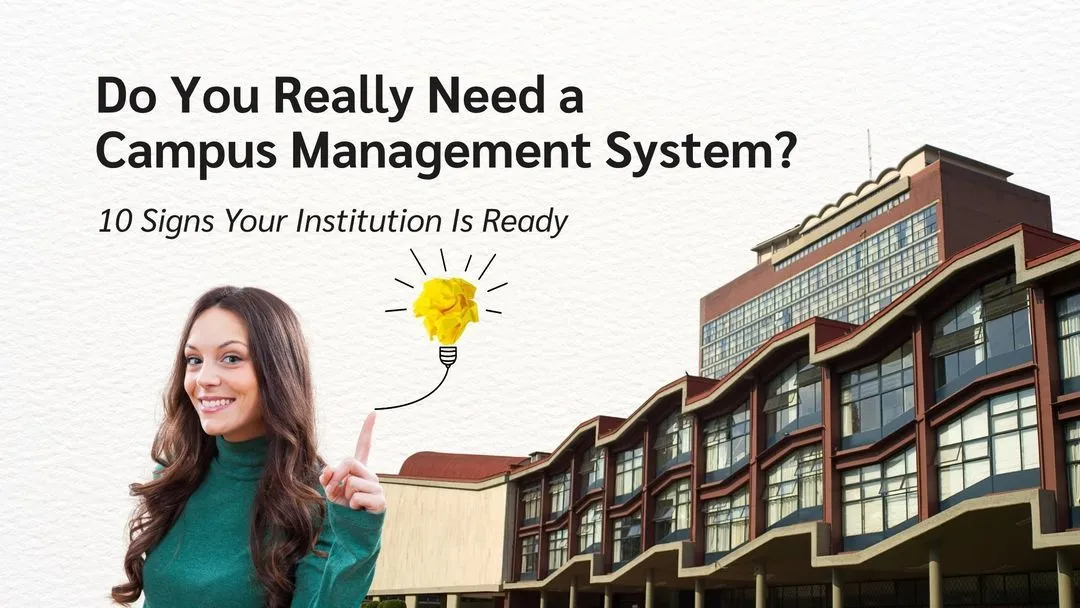
Universities and colleges in Malaysia buying a campus management system usually choose between three kinds of provider: large international higher education platforms, regional cloud platforms, and Malaysian software companies that build and adapt systems locally. Each suits a different kind of institution.
This guide explains who offers campus management systems for higher education in Malaysia, how the types of provider compare, and what to ask before you shortlist.
Quick answer: large institutions with standard processes often choose an international platform; institutions with local requirements, tight budgets or unusual processes often do better with a modular system from a local provider that can adapt it.
A campus management system runs the student lifecycle across offices: admissions and enrolment, student records, curriculum, timetabling, orientation, co-curriculum, placements, fees and reporting. It is also called a university management system, higher education ERP or, for the records part, a student information system. For a full explanation, see what is a university management system.
Global vendors whose products are used by universities in many countries. Examples include Ellucian Banner, Oracle PeopleSoft Campus Solutions and Anthology Student. They are feature-rich and proven at large scale, but are usually designed around overseas processes, so local requirements are often added through configuration, partners or custom work.
Subscription-based campus platforms built for institutions in Asia, often aimed at private colleges and universities. They are quicker to start with and priced per student, but are standard products, so changes for your specific rules may be limited or slow.
Local companies that provide their own campus products, build custom systems, or both. They know MOHE, MQA, LHDN and local payment requirements, work in the same time zone and can change the system to fit your processes. Their size and track record vary widely, so references matter.
| International platform | Regional cloud platform | Malaysian software company | |
|---|---|---|---|
| Best fit | Large universities with standard processes and a big IT team | Private colleges wanting a quick, low-setup start | Institutions with local requirements or processes that do not fit a standard product |
| Malaysian requirements | Often added through partners or customisation | Varies by vendor | Usually built in or added directly |
| Changing the system | Through configuration; deep changes are costly | Limited to what the product allows | Can be changed to fit your rules |
| Hosting | Usually vendor cloud | Vendor cloud | Your own servers or cloud |
| Cost | Highest, including implementation partners | Lower, subscription per student | Varies with scope; modular options keep it lower |
| Support | Through partners or overseas teams | Online, shared support | Local team, same time zone |
| Main risk | Long, expensive implementation | Outgrowing the product | Depends on the provider's size and track record |
For a full scoring sheet, see our student information system buyer's checklist.
GR Tech is a Cyberjaya-based software company that has built education systems for universities and colleges since 2010. Golden Campus is our campus management platform. It brings together:
Each product can run on its own, so institutions can start with one module and extend later. We deploy on the institution's own servers or in the cloud, adapt the system to local processes, and include five years of maintenance and support with every project.
As an example, we built TOPAS, the online application system for Taylor's University, which now handles more than 200 programmes and over 1,000 concurrent users. Read the TOPAS case study.
International higher education vendors (often through local partners), regional cloud platforms and Malaysian software companies such as GR Tech. The right choice depends on your size, processes, budget and how much local adaptation you need.
It depends on the number of students, the modules, data migration, integrations and hosting. Subscription platforms charge per student; project-based systems are priced on scope. Ask every provider for a five-year total cost, including support.
For standard processes, a product is faster. For processes specific to your institution, a modular product that the provider can adapt usually gives the best balance of speed and fit.
A single module can go live in a few months. A full campus system with data migration is best done in phases over a longer period.
Some can. International and regional platforms are usually cloud only. Golden Campus can be deployed on your own servers or in the cloud.
Compare Golden Campus with your shortlist
See it working with your own processes.
I'm a highly skilled project manager with extensive experience in the education technology industry. With a background in computer science and a passion for improving educational outcomes, I have dedicated my career to developing innovative software solutions that make learning more engaging, accessible, and effective.