Discover student orientation insights, tips, and strategies from experts
Guide to effective student orientations
Download the eBook





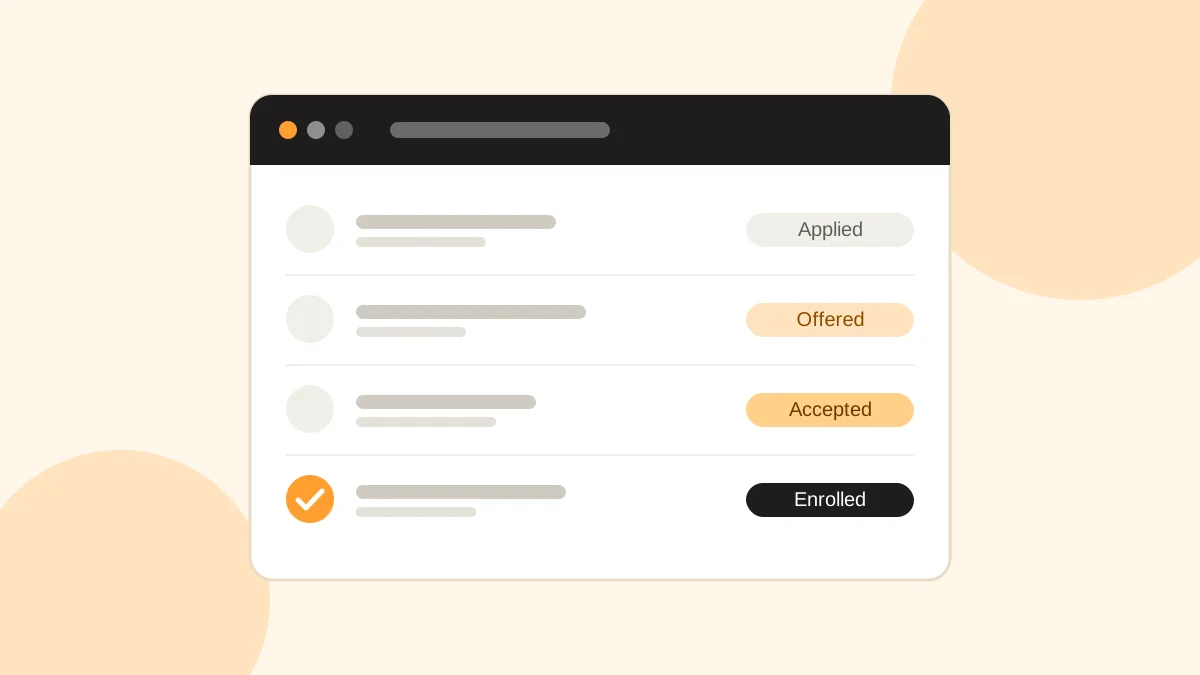
An enrollment system is the software a school, college or university uses to take in new students and keep track of who is studying what. It records each applicant, checks they meet the entry requirements, issues an offer, collects the deposit and turns the applicant into an enrolled student with a programme, an intake and a student ID. After that, it keeps the enrolment current: course registration each semester, changes of programme, deferments, withdrawals and graduation.
This guide is written for registrars and admissions officers who are asked to "look at an enrollment system" and want a plain explanation first. If you already know what one is and want to see the workflow step by step, read how enrollment management software works.
Quick answer: an enrollment system is the official list of who has applied, who has been offered a place, who has accepted and who is enrolled, plus the rules and screens that move each person from one stage to the next.
Enrollment management is the work of filling each intake with the right students: setting targets for each programme, attracting applicants, admitting them, getting them to accept and pay, and keeping them enrolled until they finish. It is a job for several offices, not one. Marketing brings in enquiries, admissions decides on applications, finance takes payments, and the registry owns the student record.
The enrollment system is the tool that holds that work together. Without one, each office keeps its own list, and the registrar spends the first weeks of every intake reconciling them.
The three words are often used as if they meant the same thing. For a registrar they are separate steps, and an enrollment system usually covers all three.
| Term | What it means | Who usually owns it | Ends when |
|---|---|---|---|
| Admission | Deciding whether an applicant meets the entry requirements and gets an offer | Admissions office | The applicant receives an offer or a rejection |
| Enrolment | The applicant accepts, pays and becomes a student on a programme and intake | Admissions and registry together | A student ID and student record exist |
| Registration | An enrolled student signs up for courses or modules for a semester | Registry and faculties | The student's timetable for that semester is fixed |
In schools, enrolment usually means placing a child in a year and class, and registration may not exist as a separate step. In universities, a student is admitted once, enrolled once per programme, and registers for courses every semester.
Products differ, but most enrollment systems for higher education include these parts:
Some institutions buy these as one system. Others use one product for admissions and another for the student record. Either way, the handover between them is where most data errors start, so it deserves as much attention as the application form.
Plenty of institutions run admissions on forms, email and spreadsheets for years. These are the usual signs that it has stopped working:
If three or more of these sound familiar, an enrollment system will save more staff time than it costs to set up.
Malaysian colleges and universities have a few needs that a generic system may not handle out of the box:
Ask any vendor to show these with your own programmes and a real intake calendar, not a demo dataset.
An enrollment system works best as the front door to the rest of the student lifecycle. It hands each new student to the student information system, sends fee and deposit data to finance, and can start orientation tasks as soon as a student accepts. In a full campus management system, enrolment is one module among timetabling, exams, finance and student services, all sharing the same student record.
Taylor's University processed programme applications manually before GR Tech built TOPAS, its online application system. TOPAS handles application review, automatic seat caps, semester-based module combinations, payment through iPay88 and Flywire, agent and counsellor management and automated offer letters, with Salesforce integration for marketing. It supports more than 200 programmes and over 1,000 concurrent users. Read the TOPAS case study.
If you are building a case for a new system, start by listing your intakes, programmes and entry rules, and count how many times a new student's details are typed in by hand today. Those two lists will tell you what the system has to do and how much time it will save.
EntriPhi is GR Tech's enrollment system. It covers intake setup by programme and campus, entry rules with automatic qualification, seat caps, offer letters, counsellor and agent case management, and payments, and it connects to student information, finance and CRM systems.
In a school, it is the software that records applications from parents, places each child in a year and class, collects fees and keeps the list of enrolled pupils up to date, including transfers in and out during the year.
In a university, it manages applications, offers, acceptances and deposits, creates the student record, and usually also handles course registration each semester and changes such as deferment or withdrawal.
Not quite. The enrollment system brings students in and manages their enrolment status. The student information system keeps the full academic record: courses, grades, attendance and graduation. Some products do both.
Admissions is one part of enrollment management. Enrollment management also covers recruitment targets, getting admitted students to accept and pay, and keeping them enrolled.
Both work. Many Malaysian public institutions prefer their own servers for data control, while private colleges often choose cloud hosting for lower upfront cost. What matters more is who maintains it and how quickly problems are fixed during an intake.
See EntriPhi with your own intake
Programmes, entry rules, offers and payments in one enrollment system.
I'm a highly skilled project manager with extensive experience in the education technology industry. With a background in computer science and a passion for improving educational outcomes, I have dedicated my career to developing innovative software solutions that make learning more engaging, accessible, and effective.