Discover student orientation insights, tips, and strategies from experts
Guide to effective student orientations
Download the eBook
-cropped.svg)


.svg)
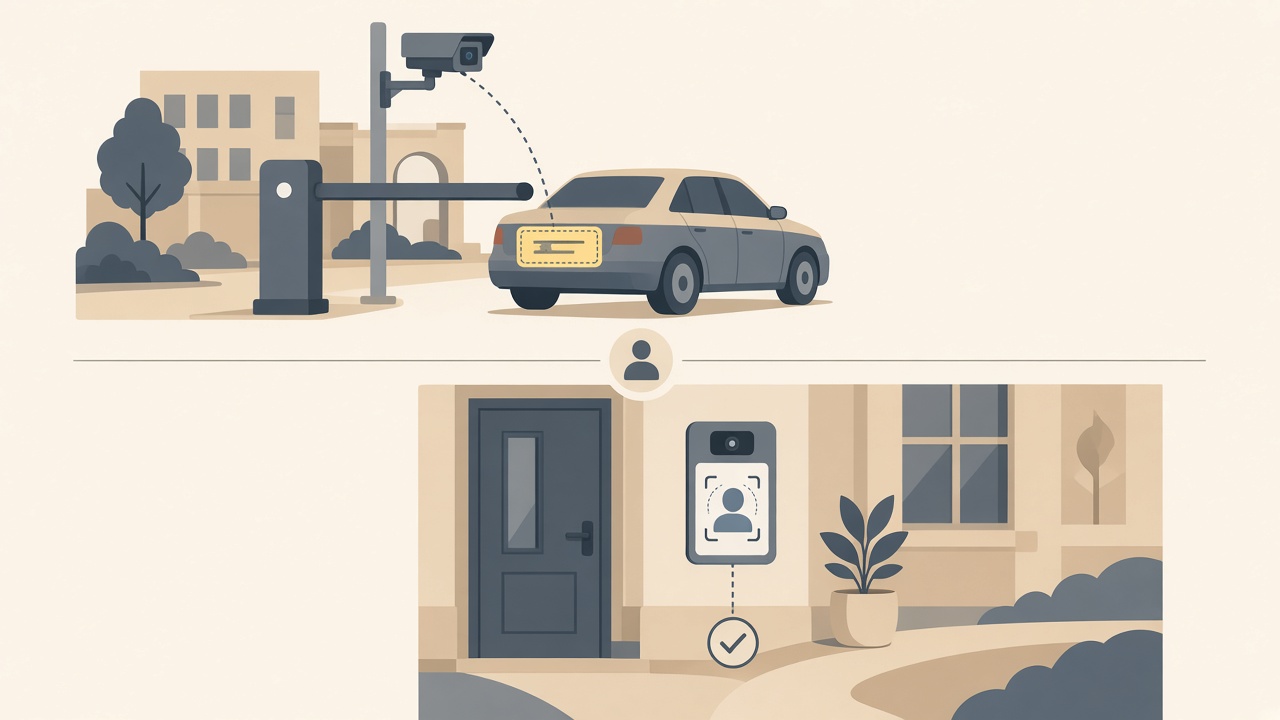
Campuses have cars and people. Security teams need both in view. Facial recognition helps at doors and walkways. ANPR (automatic number plate recognition) helps at gates and parking lots. It is a camera system that reads license plates.
Used alone, each tool covers only part of the site. Used together, they give a clearer picture of who is on campus and which vehicles belong there.
This article is for campus security leads who want one plan that covers people and cars without running two disconnected systems.
Facial recognition matches a face to an approved list. Schools use it for building entry, visitor checks, and dorm doors. You can read more about day-to-day campus uses in 8 Everyday Uses of Facial Recognition in Universities.
ANPR matches a plate to a vehicle list. It helps with staff parking, visitor lots, bus lanes, and alerts when an unknown car enters after hours.
One watches faces. The other watches plates. The overlap is the campus perimeter and the story of a visit from road to building.
A guest parks, the plate is logged, then the person checks in at a lobby kiosk. When those events sit in one system, staff can see the full path instead of two separate logs.
If something happens near a dorm or lab, teams can search by time and place across both people and vehicles. That cuts the time spent stitching camera clips by hand.
Staff cars can open a boom gate by plate. Restricted buildings can still require a face match at the door. Different layers, same policy.
This layered approach fits the wider idea in Enhancing Overall Campus Security with AI-Powered Facial Recognition.
Visitor management can sit in the middle of that path. For lobby workflows, see How Smart AI Facial Recognition Streamlines Campus Visitor Management.
You do not need every camera talking to every other camera on day one. Start where cars and people meet.
Keep vehicle lists and people lists linked by role, not by dumping all data into one open file. A contractor van list is not the same as a student face list.
ANPR needs a clear view of plates. Face cameras need steady light at door height. Test both at night and in rain before you call the pilot done.
Parents, vendors, and visiting teams still need a clean path. Pre-register plates when you can. Keep a staffed fallback at the gate.
Tell people what you collect. Separate parking logs from academic records. Delete what you no longer need. Safety work fails when trust fails.
For a broader view of campus change beyond ID cards, see Beyond ID Cards: Is Facial Recognition the Key to Campus Transformation?. For basics on how face matching works, see Facial Recognition in Universities, How It Works and Its Safety.
Do not buy ANPR and face tools from two vendors without asking how events share a time clock. If clocks disagree, incident search gets messy.
Do not put every plate and every face in one open spreadsheet. Use role-based lists.
Do not ignore signage at gates. People should know cameras read plates and faces before they enter.
ANPR watches cars. Facial recognition watches people. Together they close gaps at the edge of campus. Start at one gate and one building, prove the handoff, then grow.
Learn more about GR Tech facial recognition options if you are mapping cameras, doors, and parking into one plan.
I'm a highly skilled project manager with extensive experience in the education technology industry. With a background in computer science and a passion for improving educational outcomes, I have dedicated my career to developing innovative software solutions that make learning more engaging, accessible, and effective.