Discover student orientation insights, tips, and strategies from experts
Guide to effective student orientations
Download the eBook
-cropped.svg)


.svg)
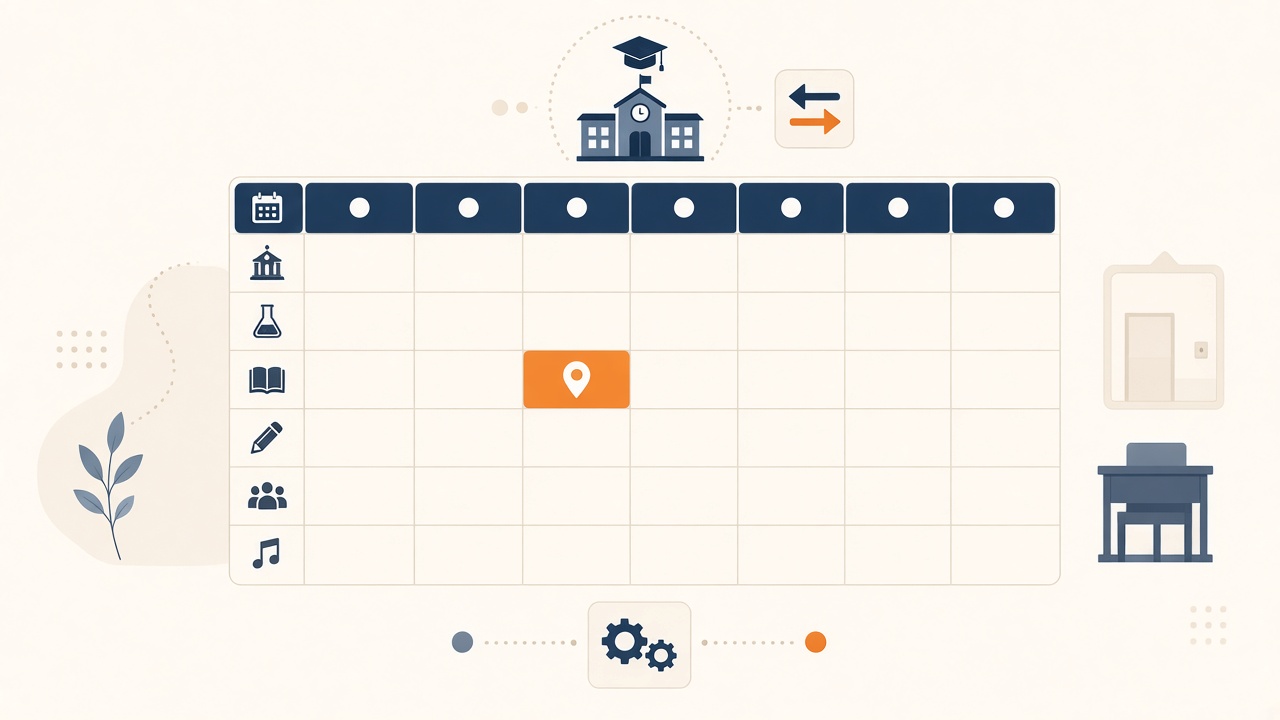
Building a school timetable by hand is slow and fragile. One teacher clash, one missing room, or one late change and the whole week starts over. Staff lose evenings. Students get wrong rooms. Substitutes scramble.
Automated timetable management software builds and updates schedules with rules you set: teacher availability, room capacity, subject blocks, and constraints you cannot break. It does not remove human judgment. It removes the endless rebuild.
This guide is for principals, academic coordinators, and IT leads who want fewer clashes and faster updates.
A strong system usually covers:
You still decide policy. The software applies it consistently.
Teachers, rooms, electives, and fixed periods interact. Spreadsheets hide conflicts until someone notices in week two.
A single maternity leave or lab outage can force a full redraw. Automation localizes the change.
Without clear load reports, some teachers carry more free periods while others stay overloaded.
Hard rules (no double-booking a teacher) and soft rules (prefer morning maths) should be visible and editable.
When two needs collide, the system should show options, not only a red error. More on that in Algorithmic Conflict Resolution.
Last-minute absence should not mean a phone tree and a blank board. See Teacher Substitutions & Last-Minute Absence.
Empty labs while other rooms overflow is a cost problem. Covered in Optimizing Campus Classroom & Lab Space Utilization.
Universities and senior secondary tracks need choice-aware scheduling. See Elective Course Scheduling & Student Choice.
Many campuses still live in Excel. It works until the model grows. For a direct comparison of time and errors, read Manual Excel Timetables vs Automated Timetabling Software.
Timetabling is strongest when it shares teacher and student records with your wider school system. Attendance, rooms, and staff data should not be typed twice.
If you are still choosing the broader platform, start with School Management Software: The Definitive 2026 Guide.
Automated timetable software pays off when change is constant and clashes are costly. Clear rules, clean data, and a link to your school records matter as much as the solver itself.
For day-to-day campus operations beyond scheduling, GR Tech's campus management system overview is a useful next step.
I’m Ahmad Ahsan, founder and CEO of GR Tech. Since starting the company in 2010, I’ve been focused on helping schools and businesses get access to high quality, scalable software without the usual complexity or cost barriers. I’m especially passionate about innovation in education, whether it’s building AI powered tools for libraries or creating smarter systems that make life easier for students and staff.
At the end of the day I believe technology should feel simple, practical and genuinely useful.